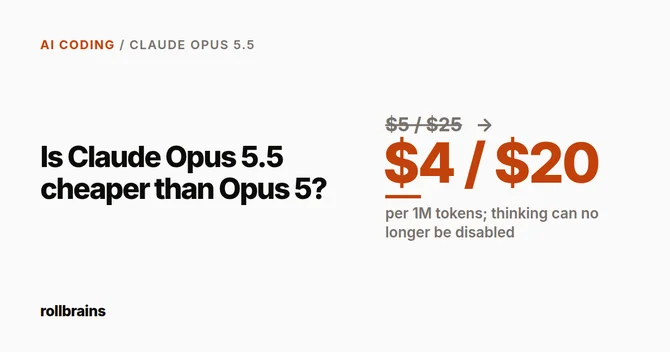
Claude Opus 5.5 list price of $4 input and $20 output per million tokens, down from $5 and $25 on Opus 5

Claude Opus 5.5 Pricing vs Opus 5: Costs, Savings and the Thinking-Token Break-Even

💡 TL;DR / Summary — Claude Opus 5.5 Pricing (BLUF) Question: Is Claude Opus 5.5 actually cheaper than Opus 5, now that its thinking can’t be switched off? Measurement: From Anthropic’s official price list, the same token counts cost 20% to 35.5% less on Opus 5.5 across three workload shapes. The saving is larger when more of the input is cached. Catch: Thinking is billed as output. If Opus 5.5 produces more than +41.7% output for an uncached request (+32.3% for a cached session), it costs more than Opus 5. Rule: Switch cache-heavy agent work first; measure thinking_tokens before moving workloads that ran Opus 5 with thinking off. Anthropic released Claude Opus 5.5 on September 22, 2026 at $4 per million input tokens and $20 per million output tokens, 20% below Opus 5, with cache reads cut 60% to $0.20. The announcement also states that Opus 5.5 “is also no longer available with ’thinking’ mode switched off.” ...
September 28, 2026 · 8 min · Steve
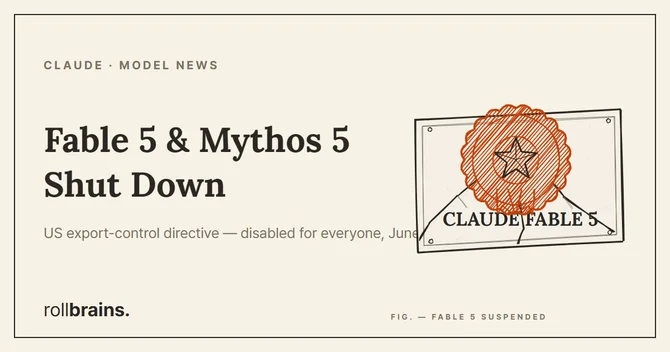
Claude Fable 5 was suspended on June 12, 2026 and restored on July 1, 19 days later

Claude Fable 5 Shutdown and Restoration: US Export-Control Timeline and Current Models

💡 TL;DR / Summary (BLUF) What happened: On June 12, 2026, a US export-control directive forced Anthropic to suspend Claude Fable 5 and Mythos 5. Unable to separate users by nationality in real time, Anthropic disabled both models for every customer worldwide. Resolution: The Department of Commerce lifted the controls on June 30, and Anthropic restored Fable 5 on July 1, 19 days after the suspension. Mythos 5 came back only for a set of approved US organizations. What to use now (September 2026): Fable 5.1 (shipped September 1, $10/$50 per million tokens) for the hardest work, or Opus 5.5 ($4/$20) as the cheaper heavy-coding default. Leaving your model on default is still the safest setting. “The US government, citing national security authorities, has issued an export control directive to suspend all access to Fable 5 and Mythos 5 by any foreign national, whether inside or outside the United States, including foreign national Anthropic employees.” — Anthropic, official statement, June 12, 2026 ...

June 13, 2026 · 5 min · Steve
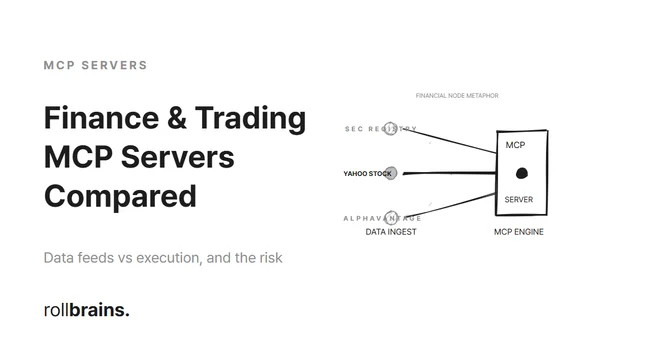
Finance & Trading MCP Servers compared

Finance and Trading MCP Servers, Compared (2026)

💡 TL;DR / Summary - Finance & Trading MCP Servers Key Summary (BLUF) Dual Server Architecture: The financial MCP ecosystem is split into “Data Feed Servers” (which query prices, news, and fundamentals) and “Execution Servers” (which place real orders). Load-bearing Risks: Execution servers carry massive transactional risk if the agent hallucinates tokens, requiring strict Paper Trading safety nets. Data feeds carry interpretation risks (ratio calculations) requiring human-in-the-loop audit. Platform Integration: Official offerings from Alpha Vantage, Alpaca, and Financial Datasets provide clean integration into Claude Desktop, Cursor, and TradingView Remix for advanced chart automation. “Trading and data APIs exposed over MCP allow LLMs to directly reason over live market feeds and portfolios, bypassing static tools.” — Model Context Protocol Financial Integration Guidelines, 2026 ...

May 22, 2026 · 9 min · Steve
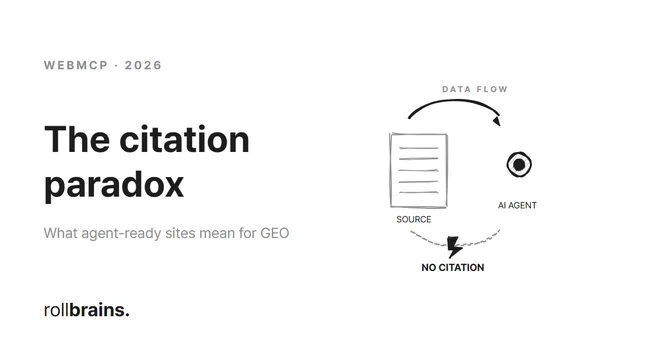
WebMCP and the Citation Paradox

WebMCP and the Citation Paradox — What Agent-Ready Websites Actually Mean for GEO

💡 TL;DR / Summary - WebMCP & The Citation Paradox Key Summary (BLUF) Direct Tool Calling vs. Citation: WebMCP enables agents to execute tools in browser tabs without DOM scraping, but W3C specs do not guarantee user-facing citations. Zero-Click Traffic Shifts: While transactional platforms benefit from direct conversions, publishers face an amplified zero-click referral traffic drop. Hybrid Optimization Model: To optimize for GEO, run a dual setup: a static layer (structured data, comparison tables) for citations and WebMCP tools for actions. “The User Agent MAY present tools to the model using Model Context Protocol (MCP), a proprietary function calling representation, or any other format.” — W3C Web Machine Learning CG Draft, Section 3.1 ...

May 21, 2026 · 12 min · Steve