A centralized repository of systematic and quantitative trading strategy research. Focused on exposing statistical biases, transaction friction drags, and structural limitations.
This repository serves as a transparent Quantitative Trading Strategy Research Hub.
We prioritize documenting and publishing “failed strategies (negative results)” to challenge common geometric assumptions and retail backtesting illusions. Every research paper features high-fidelity historical data audits, ECN commission modeling, and out-of-sample stress testing.
Correlation Is Not a Direction Signal: Inside a 98% Reversion, 47.47% Win-Rate Real-World Failure
馃挕 Key Takeaways
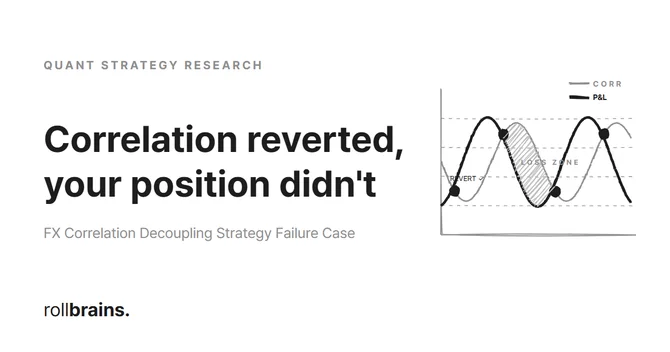
The Reversion Fallacy: The rolling correlation Z-score successfully converged to its baseline with a stellar 98.01% probability, but the directional trades placed on the decoupled legs yielded a dismal 47.47% win rate. Lack of Directional Alpha: Correlation reversion can occur via multiple distinct price paths (Dynamic Drift). A relative spread convergence does not guarantee a specific direction for either individual asset. Trading a relational indicator as a single-instrument direction signal is statistically identical to a coin flip. Safe-Haven Turbulence: JPY cross-pairs structurally violate the mean-reversion assumption during global risk-off regimes, trending aggressively in one direction. Adding broker fee friction completely devours any remaining micro-alpha. This report is part of the COREX negative-result archive, published transparently in our Quant Strategy Research Hub. All figures presented in this article are verified empirical results obtained under the PRISM-R Framework v4.6.0 using a high-fidelity 10-year FX historical dataset, independent of any commercial software or affiliate marketing schemes.
...