💡 Key Takeaways
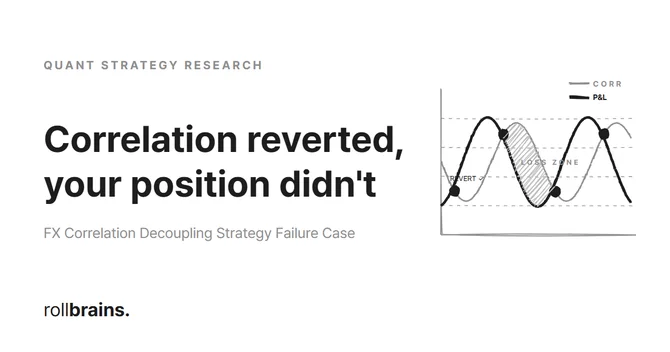
- The Reversion Fallacy: The rolling correlation Z-score successfully converged to its baseline with a stellar 98.01% probability, but the directional trades placed on the decoupled legs yielded a dismal 47.47% win rate.
- Lack of Directional Alpha: Correlation reversion can occur via multiple distinct price paths (Dynamic Drift). A relative spread convergence does not guarantee a specific direction for either individual asset. Trading a relational indicator as a single-instrument direction signal is statistically identical to a coin flip.
- Safe-Haven Turbulence: JPY cross-pairs structurally violate the mean-reversion assumption during global risk-off regimes, trending aggressively in one direction. Adding broker fee friction completely devours any remaining micro-alpha.
This report is part of the COREX negative-result archive, published transparently in our Quant Strategy Research Hub. All figures presented in this article are verified empirical results obtained under the PRISM-R Framework v4.6.0 using a high-fidelity 10-year FX historical dataset, independent of any commercial software or affiliate marketing schemes.
1. Introduction: The Retail Illusion of Geometric Convergence
In the retail systematic trading community, it is a widely held geometric belief that when the rolling correlation between two historically linked currency pairs decouples (exceeds $1.5\sigma$), they will inevitably snap back to their baseline equilibrium. Under the assumption that correlation reversion must dictate individual price direction, retail traders frequently place directional trades on the diverging leg.
This research paper presents the empirical deconstruction of this exact setup: using FX cross-pair correlation decoupling as a single-instrument mean-reversion directional trigger. The statistical findings reveal a harsh reality: the correlation Z-score converged to its baseline with a near-perfect 98.01% probability, yet the resulting equity curve was a mathematical path to absolute ruin.
2. Quantitative Strategy & Backtest Architecture (COREX)
To ensure the scientific integrity of the backtest, we implemented rigorous data governance rules and realistic ECN fee models.
- Universe: 8 major FX cross-pairs (
AUDJPY,AUDNZD,CADCHF,EURAUD,EURCHF,EURGBP,EURJPY,GBPJPY) - Historical Data: January 1, 2015 – March 31, 2025 (10-year high-fidelity H4 OHLCV dataset, 70/15/15 split)
- Friction Model: ECN Raw spread + round-trip commissions totaling $2.2 \sim 3.4$ pips per trade (1x realistic cost)
- Total Events: 1,108 unique entry triggers extracted during the Discovery period
Execution and Exit Rules
When the 40-bar rolling correlation Z-score between two pairs diverges beyond $1.5\sigma$ from its baseline, we execute a single directional trade (Long or Short) with a standardized 1R risk size on the weaker cross-pair. The position is exited immediately when the Z-score reverts to its normal range ($|Z| < 0.5$) or when a hard 120-bar timeout is reached.
⚠️ Critical Distinction: This setup is NOT a market-neutral spread pairs trading strategy where both legs (Long A + Short B) are held concurrently to capture the spread. This is a single-instrument directional exposure placed on one cross-pair when its correlation decouples—a highly popular retail strategy that assumes correlation implies direction.
3. The 98% Reversion vs. 47.5% Win-Rate Paradox
The backtest results revealed an extraordinary statistical divergence: the rolling correlation Z-score reverted to its baseline in 98.01% of the 1,108 entry events (1,086 events). The relationship-level signal behaved exactly as mean-reversion mathematics predicted—the correlation decoupling almost always normalized.
However, the actual trade win rate was a dismal 47.47% (526 events). Of the successfully reverted events, 51.57% (560 events) closed with a net negative P&L. While the signal reverted successfully with a 98.01% probability, the trading account lost money with an overall failure rate of 52.53% (582 events, including 22 losses from failed reversions).
This profound disconnect exists because signal reversion rate and trade win rate are entirely independent statistical dimensions.
💡 Core Insight
- Reversion Rate measures whether the relative distance between two assets returned to its historical mean.
- Trade Win Rate is determined by whether the specific asset entered moved in the predicted direction. These are mathematically distinct questions.
4. Why Does a Reverting Signal Still Lose Money?
A correlation Z-score can converge back to zero via multiple distinct geometric paths. All three of the following scenarios are recorded as a “successful reversion” by the model:
- Asset A falls and normalizes: The cross-pair falls. A short position entered on the decoupling yields a profit.
- Asset B rises and normalizes: The cross-pair rises. A short position entered on the decoupling yields a loss.
- Both assets move together in the same direction (Dynamic Drift): The cross-pair price direction is highly volatile and undetermined, typically resulting in a loss after transaction costs.
Correlation convergence is merely the event of two assets moving closer to each other. It does not dictate which of the two assets will perform the physical work of convergence.
The direction of an individual cross-pair is governed by the isolated, idiosyncratic supply and demand of its component currencies, not by the abstract correlation structure. Attempting to extract single-instrument directional alpha from a relative relationship signal degrades into a mathematical coin toss.
5. Directional Signal vs. Coin Flip (Random Baseline)
To prove whether the correlation decoupling signal held any predictive value, we compared the expectancy of the actual strategy direction against a completely randomized direction baseline.
- Strategy Direction Expectancy (0x cost): -5.86 pips
- Random Direction Expectancy (0x cost): +1.76 pips
Even in a friction-free environment (0x), the random entry baseline outperformed the strategy’s mathematical signal. While the difference did not achieve strict statistical significance on our sample test ($p \approx 0.61$), this conclusively proves that the correlation decoupling signal provides zero directional edge over a coin flip.
6. Can More Features or Machine Learning Fix It?
To address the common machine learning objection—“the signal exists, the model is just too simple”—we checked 15 advanced mathematical features spanning correlation velocity, relative currency strength, cointegration half-life, volatility ratio, and execution session timing against the final trade direction.
| Analyzed Feature | Pearson correlation (Pearson r) | Mutual Information (Mutual Info) | Permutation Importance (Perm Imp) |
|---|---|---|---|
| ccy_a_strength_z (Currency Strength Z) | 0.030 | 0.040 | 0.016 |
| hurst_exponent (Hurst Exponent) | 0.042 | 0.000 | 0.020 |
| z_velocity (Reversion Velocity) | 0.048 | 0.027 | 0.003 |
| coint_pvalue (Cointegration p-value) | 0.051 | 0.023 | 0.001 |
| vol_ratio (Volatility Ratio) | 0.020 | 0.007 | 0.009 |
Across all 15 features, the maximum absolute Pearson correlation ($|r|$) was a negligible 0.066. Linear, non-linear, and ensemble-based feature importances all converged below the statistical noise threshold.
While a shallow Decision Tree (max_depth=3) identified a high-performing leaf node with a $66.7$% in-sample win rate (N=24, expectancy +72.15 pips), the node’s risk-adjusted performance (Sharpe) collapsed by 435% on the out-of-sample validation set. This was a classic case of overfitting to a tiny, currency-specific sample (EURAUD), not a generalizable market pattern. No amount of machine learning complexity can extract alpha from a dataset that contains no signal.
7. The JPY Safe-Haven Structural Conflict
The aggregate negative expectancy (-5.86 pips) was heavily driven by a specific, macro-structural cohort: the Yen (JPY) cross-pairs.
| JPY Cross-Pair | Sample Size (N) | Expectancy (0x cost, pips) |
|---|---|---|
| AUDJPY | 134 | -16.85 |
| EURJPY | 131 | -1.88 |
| GBPJPY | 140 | -36.28 |
The Japanese Yen acts as a global safe-haven carry currency. During systemic market shocks or massive risk-off cycles, macro-liquidity flows and carry-trade unwinds trend JPY pairs violently and unilaterally in one direction.
The resulting correlation decoupling is not a temporary statistical aberration, but a fundamental, structural shift in macro regimes. Under these conditions, the mean-reversion assumption is completely invalidated. This explains the catastrophic historical liquidations (such as the Quant Bust of 2007 or 2020) suffered by statistical arbitrage funds that relied blindly on correlation mean-reversion during crisis regimes (see Quant Bust 2020, arxiv.org/pdf/2006.05632).
Excluding the JPY pairs, the remaining five non-JPY pairs achieved a positive raw expectancy of +1.55 pips. However, this marginal edge was entirely consumed by transaction fees.
8. Broker Commissions and Extreme Tail Risk
The following table summarizes the performance of the strategy under varying commission and spread friction levels (0x to 2.5x).
| Config Segment | N | Expectancy (0x) | Expectancy (1x Real Cost) | Expectancy (2.5x Stress) | Realized Sharpe (1x) |
|---|---|---|---|---|---|
| All 8 Pairs | 1,108 | -5.86 | -8.60 | -12.71 | -1.289 |
| Non-JPY 5 Pairs | 703 | +1.55 | -1.11 | -5.24 | -0.106 |
* Sharpe ratios are annualized based on N=1,108 events over 123 months (n_per_year = (N/months)*12 = 108.09).
Even in a hypothetical frictionless world (0x), the risk-adjusted Sharpe ratio was negative. When realistic broker fee drags (1x) were applied, even the non-JPY segment’s positive expectancy was dragged into negative territory.
Beneath the 98.01% reversion rate hid a massive, asymmetric Tail Risk. The average loss in the worst 1% of trades (CVaR99) was 605 pips, with a VaR99 of 494 pips. A tiny fraction of extreme trend-continuation events completely wiped out hundreds of minor, profitable correlation-reversion trades.
9. Four Reusable Quantitative Validation Rules
The rigorous deconstruction of this failed strategy yields four foundational validation rules applicable to all statistical arbitrage and mean-reversion strategies:
- Measure signal accuracy and P&L accuracy independently from Day One.
- Reversion rate (98.01%) and trade win rate (47.47%) belong to different dimensions. Folding them together creates a dangerous retail illusion.
- Execute a random-direction benchmark before building any data pipelines.
- If your complex mathematical strategy cannot outperform a simple coin flip in raw expectancy, stop the research immediately. Do not waste resources building machine learning models.
- Validate direction mapping on a small 50-event manual sample first.
- A dismal ~47% win-rate performance would have been flagged instantly in a 50-event manual audit, saving months of infrastructure development.
- Isolate structural segments before aggregating statistics.
- Systemic macro assets like the JPY act as outlier anomalies that hide inside the overall average. Always evaluate per-pair and per-group expectancies first.
10. Conclusion: Boundaries of the Negative Result
- What this article does not claim: We do not claim that market-neutral pairs trading is dead. Cointegration-based spread trading (holding both Long A and Short B legs simultaneously) translates convergence directly into spread P&L, which differs fundamentally from the single directional bet tested here. Cointegration and correlation are structurally distinct (see correlation vs mean reversion, QuantConnect research).
- What this article supports: Correlation remains a highly valid, institutional tool for portfolio risk management, exposure estimation, and diversification. What fails is using correlation reversion as a predictive directional trigger for a single instrument.
11. FAQ
If correlation converges, isn’t the trade always profitable?
No. Convergence only means the relative distance between the two assets narrowed. Whether the single instrument you chose to enter moved in the profitable direction is a separate question. In this backtest, the reversion rate was 98.01%, but the win rate was 47.47%.
Can we fix this strategy by adding a tight Stop Loss?
No. Adding an ATR×2.0 stop loss left the expectancy virtually unchanged (EV 0x -5.86). Over 52.7% of trades hit the stop loss, proving that the entry direction itself was fundamentally flawed, not the risk management.
Why did JPY pairs perform so poorly?
The Japanese Yen is a global safe-haven currency. During market crises, JPY pairs trend aggressively and unilaterally, violating the mean-reversion assumption. The JPY cross GBPJPY recorded the worst expectancy at -36.28 pips.
Does this mean correlation is useless for trading?
No. Correlation remains a highly valid tool for portfolio risk management, exposure estimation, and diversification — knowing two instruments move together tells you how much overlapping risk you carry. What fails is the opposite use: treating a correlation-reversion signal as a directional predictor for a single instrument.
How is this different from cointegration-based pairs trading?
A cointegration spread trade holds both legs at once (long A, short B), so a convergence event maps directly into spread P&L regardless of which leg moved. The strategy tested here was a single directional bet on one leg — structurally different, which is why convergence (98.01%) did not translate into wins (47.47%).
Related Research
- The complete picture — start with the hub: 7 Ways Your Backtest Is Lying to You (Measured, Not Guessed) — this correlation-reversion failure is one of seven measured failure modes cataloged there; see how a 98.01% signal-level success rate collapsing into a 47.47% trade win rate stacks up against the other six.
- The Backtest Autopsy Series:
- The Backtest Autopsy #1: Entry Price is the Edge: If a 98% reversion probability can still produce a losing account, execution quality is no rounding error — this piece isolates exactly how much edge entry price alone can consume before correlation logic ever enters the picture.
- Debugging the Look-Ahead Bias ChatGPT Can Never Catch: The same audit discipline applies to a reversion signal like the one tested here — an undetected look-ahead leak can manufacture a phantom directional edge out of what is actually pure correlation noise.
- Slippage Simulation: Measuring Execution Latency and Account Decay: This article’s non-JPY segment went from +1.55 pips raw to -1.11 pips once 1x real-world cost was applied — a swing driven entirely by execution friction; this piece quantifies that friction directly.
- Market Regimes and Regime Synchronization Analysis: The JPY safe-haven trend break that invalidated this strategy’s mean-reversion assumption is itself a regime shift — this piece covers detecting and adapting to those shifts systematically.
- Correlation is Not Directional: Statistically Demystifying Multi-Asset Convergence: Quantitative proof of why asset correlation does not imply trade direction.
- Implementation:
- TradingView Pine Script v6 Footprint Indicator Guide: To build a custom correlation-decoupling detector instead of relying on this study’s fixed Z-score trigger, this guide covers writing lookahead-safe custom indicators in Pine v6.
Educational content only — not investment or financial advice. Data, prices, and tool specifications change; verify independently and paper-trade before risking capital.