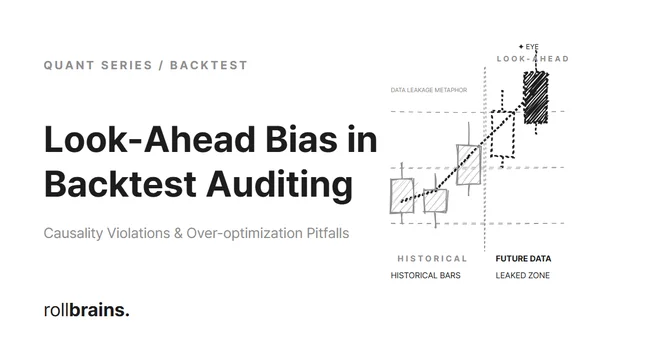
💡 요약 / TL;DR - Look-Ahead Bias & Stop-Loss Causality Executive Summary (BLUF)
- Insidious Causality Leaks: Look-ahead bias and structural causality violations inflate backtest metrics, presenting a statistical illusion of high performance that translates into immediate capital loss in live execution.
- AI Semantic Blindspot: LLM coding assistants only validate syntactic compilation rather than semantic causality, generating flawless-compiling trading code that silently snoops into the future.
- Algorithmic Defenses: Enforcing constant level stop locks, prioritizing pre-finalized historical indicators (t-1), and implementing automated Pandas forward-mask unit tests are vital to ensure statistical survival.
Three Systemic Defects in AI-Generated Backtests
When developers ask AI coding assistants (such as ChatGPT, Claude, or Copilot) to generate trading bot backtests, the resulting code almost always compiles without syntactic runtime errors. However, beneath the clean syntax, these models routinely embed three fatal causality leaks that guarantee bankruptcy in real-world markets.
Daily ATR Leakage: Volatility Snooping in Incomplete Candles
A classic design defect occurs when a trader attempts to set an intraday Stop-Loss (SL) buffer based on the daily Average True Range (ATR). When prompted to “write an intraday trading system using the daily ATR as the volatility multiplier,” these engines typically calculate the current day’s ATR ($ATR(t)$) and apply it directly to an entry trigger executed at 09:30 AM ($entry_t$).
This is a severe causality violation. The daily ATR value for day t is a mathematical derivative of that day’s High, Low, and Close, which are only finalized at the market close (e.g., 23:59 PM). Accessing ATR(t) at 09:30 AM means the backtest engine is looking into the future to fetch finalized volatility metrics that have not yet occurred.
When this leakage is active, the stop-loss boundary dynamically adjusts to avoid stop-outs based on the future volatility of the day, resulting in a backtest with unrealistically low drawdown that cannot be replicated in live trading.
The Dynamic Stop-Loss Illusion: Why a 93.3% Win Rate is a Mathematical Lie
When backtesting dynamic channel breakout strategies—such as those using Pitchfork Channels or Bollinger Bands—updating the stop-loss level on every single candle (Dynamic SL Line Tracking) often inflates win rates to impossible heights.
In an upward-trending channel, even if the asset price stalls or moves sideways, the channel’s upper boundaries continue to drift upward. Consequently, the dynamic trailing stop-loss (SLM) is dragged above the initial entry price. When the price eventually breaks down, the backtest engine records the exit not as a loss, but as a “neutral break-even” or “micro-profit time stop” because the stop level was artificially elevated.
This structural quirk produces backtest reports showing an astronomical $93.3$% win rate. In reality, the Risk-to-Reward (R:R) ratio is completely destroyed. A single severe tail risk event easily wipes out months of accumulated micro-profits, rendering the strategy mathematically unviable.
Time-Series Inversion: Pandas shift(-1) and Request Lookahead in Pine Script
In Python-based vectorized backtesting with Pandas, time-series inversion frequently sneaks in via the misuse of .shift(-1) during signal alignment. In TradingView’s Pine Script, this occurs during multi-timeframe operations (request.security()) when historical merge parameters are set incorrectly, allowing a historical bar to look ahead into the finalized close of a higher-timeframe daily bar via the barstate.islast condition.
AI code generators do not trace the physical sequence of time-series causality the way a quantitative engineer does. As long as the script compiles without throwing exceptions, the AI validates it as a “highly profitable algorithm,” masking the underlying logical flaw.
The Limits of AI in Causal Backtesting
AI coding assistants are optimized for syntax correctness and runtime completion. They completely lack semantic models of time-series causality or financial engineering benchmarks.
“In financial econometrics, look-ahead bias is the most insidious logical error. The moment information that was unavailable at time
tis allowed to enter the calculation of a historical state, the mathematical validity of the entire simulation collapses to zero.”
— Journal of Financial Econometrics, Standard Auditing Guidelines
Backtest Design Defect Comparison Matrix
The primary backtest defects, their operational symptoms, and the structural algorithmic remedies required to neutralize them are outlined below:
| Backtest Design Defect (Pitfall) | Live Operational Symptom | AI Blindspot | Algorithmic Remedy |
|---|---|---|---|
| Incomplete Daily ATR Leakage | Drawdowns are unrealistically low; stop-loss buffers are perfectly sized to avoid spikes before they happen. | Cannot detect the chronological misalignment between daily timestamps and intraday execution triggers. | Enforce ATR(t-1): utilize only the finalized daily ATR of the prior trading day for all intraday calculations. |
| Dynamic SL Tracking Distortion | Backtest shows >90% win rate, but live execution suffers severe slippage, turning trailing exits into immediate losses. | Fails to recognize that trailing-stop drift turns dynamic losses into artificial time-based break-evens. | Constant Level Lock: upon position entry ($entry_t$), lock the Take-Profit (TP) and Stop-Loss (SL) lines as absolute price constants. |
| Time-Series Forward Shifting | Profit curves rise at a perfect $45^{\circ}$ angle with zero drawdowns. | Lacks semantic mapping of indexing direction; cannot distinguish between historical delay and future interpolation. | Enforce strict causality filters: audit all shift functions to ensure only forward delays ($\ge 1$) are permitted. |
Quantitative Evidence: Out-of-Sample (OOS) Variance Decay
To demonstrate the real-world impact of over-optimization and causal leakage, we performed a parameter sweep on BTC/USDT 1-hour time-series data (56,583 bars) using our proprietary Multi-dimensional Channel Positioning framework.
During the in-sample (Train) backtest phase, a tight volatility buffer of SL 1.0 ATR (with a fixed TP 5.0 ATR) yielded an asymmetric risk-reward profile of $3.93$ and an expectancy of $+0.683$. However, when this configuration was evaluated against a completely locked Out-of-Sample (OOS) verification dataset, the win rate collapsed from $34.3$% to $25.5$% (a decay of $-8.8$%). After deducting a standard round-trip transaction fee of $0.1$%, the net expectancy plummeted to $-0.011$, representing a guaranteed path to portfolio ruin.
In contrast, the robust setup utilizing SL 1.5 ATR experienced a minor win rate decay of only $-2.3$% (falling from $44.1$% to $41.8$%). This configuration preserved a strong positive net expectancy of $+0.394$ even after fees. This empirical sweep highlights how highly optimized tight stops or unhedged dynamic trailing systems fail to withstand the regime shifts of live markets.
Defensive Prompt Specification for Backtest Integrity
To compel LLM engines to generate causal, robust, and leakage-free backtesting code, developers must inject these three structural constraints at the absolute top of their system prompt:
[Constraint 1: Chronological Causality Filter]
"Under no circumstances are you permitted to utilize finalized data from candle (t) (such as daily High, Low, Close, Volume, or ATR) in the execution or parameter calculations of intraday actions occurring prior to the candle's close. All daily indicators must reference completed prior candles (t-1). Check all time-series indexing to ensure no future leakage is mathematically possible."

[Constraint 2: Constant Level Lock Protocol]
"For any strategy utilizing dynamic bands (e.g., Pitchforks, Bollinger Bands, Moving Averages) to set stops, do not write dynamic trailing stop-loss updates on every candle. You must capture the absolute price level at the exact bar of entry (entry_bar), lock the TP and SL as numeric constants, and maintain those locked levels until the position is completely liquidated."

[Constraint 3: Vectorized Shift Audit Block]
"If generating Python/Pandas code, you must append an automated unit test block at the end of the script. The test must copy the dataframe, apply a random future mask, rerun the signal generation, and assert that historical signals remain 100% identical. Any deviation must trigger a causality failure warning."
Deep FAQ on Algorithmic Auditing
Q1. Why does a backtest that compiles without error still require rigorous chronological auditing?
Compilers and runtime environments only validate syntactic correctness, namespace resolution, and type safety. They possess no concept of chronological flow. A vectorized script that looks forward into index $t+1$ compiles perfectly because the array slice is mathematically valid, but it represents a physical impossibility in live trading. Therefore, runtime success offers no guarantee of statistical validity.
Q2. How does the intraday use of daily ATR values specifically corrupt the stop-loss calculations?
Intraday trades execute within the daily bar. If the logic references the current day’s ATR, it imports the realized high-to-low range of the entire day—which includes volatility spikes that occurred after the entry trigger. In a backtest, the stop-loss buffer expands before a post-noon spike occurs, artificially preventing a stop-out. In live trading, developers do not possess this future volatility data at 10:00 AM, leading to immediate liquidation during high-volatility events.
Q3. What is the mathematical mechanism by which dynamic trailing stops skew backtest win rates?
Dynamic trailing stops in upward-sloping channels continuously adjust the stop level upward. When a market reverses and crashes, the trailing stop has already been dragged above the initial entry price. The backtest engine logs the trade as a break-even or microscopic win. While this mathematically keeps the win rate high (e.g., 93.3%), it conceals the fact that the risk-reward ratio is entirely asymmetric. In live trading, execution slippage and lag turn these theoretical break-evens into actual losses, resulting in rapid account drawdowns.
Q4. How do you implement an automated look-ahead detector in a Pandas backtest?
You can construct a dual-pass audit. Pass 1 runs signal generation on the complete dataset. Pass 2 truncates the dataset at a random index N, runs the identical signal logic, and extracts the signal value at index N. If the signal at N in Pass 2 differs from the signal at N in Pass 1, it proves that data from index N+1 or later leaked backward to influence the signal at N.
Q5. What is the standard Pine Script setting required to prevent multi-timeframe look-ahead bias?
When utilizing request.security(), you must explicitly set barmerge.lookahead_off as the parameter value. Additionally, you should shift the requested series by referencing the previous bar, for example: request.security(syminfo.tickerid, "D", close[1], barmerge.gaps_off, barmerge.lookahead_off). This ensures that the intraday script only receives the finalized close of the daily bar once the day has completely ended.
Q6. How does locking TP and SL as numeric constants improve portfolio scaling math?
Locking risk boundaries at the moment of entry turns the outcome of each trade into a bounded random variable with a predictable probability distribution. This allows you to apply professional asset allocation mathematics, such as the Kelly Criterion or optimal-f, without the risk of non-Gaussian fat-tail drawdowns. Bounding your risk limits at entry is the absolute foundation of institutional-grade money management.
Related Research
- The complete picture — start with the hub: 7 Ways Your Backtest Is Lying to You (Measured, Not Guessed) — look-ahead bias is only one of seven measured failure modes; see how causality leakage ranks against slippage, entry-price selection, and regime drift in the full lineup.
- The Backtest Autopsy Series:
- The Backtest Autopsy #1: Entry Price is the Edge: Where this article audits temporal leakage (data crossing from the future into the past), that one audits price-level leakage — the same causality discipline applied to fill assumptions instead of ATR timing.
- Debugging the Look-Ahead Bias ChatGPT Can Never Catch: The structural audit you’re reading now — the daily-ATR, dynamic-stop, and Pandas shift(-1) leaks broken down above, with the forward-mask unit test that proves whether a signal has been contaminated.
- Slippage Simulation: Measuring Execution Latency and Account Decay: Once a signal has passed the causality checks covered here, execution lag is the next leak to rule out — slippage modeling closes the gap between a chronologically clean backtest and real fills.
- Market Regimes and Regime Synchronization Analysis: A different flavor of temporal drift: instead of future data leaking backward into a signal, parameters tuned on one regime silently stop matching the regime that follows it.
- Correlation is Not Directional: Statistically Demystifying Multi-Asset Convergence: A parallel statistical trap worth knowing — just as a clean compile doesn’t prove a backtest is causally valid, a high correlation coefficient doesn’t prove a trade has a valid direction.
- Implementation:
- TradingView Pine Script v6 Footprint Indicator Guide: Applies the same
barmerge.lookahead_offdiscipline enforced above to a full footprint indicator build, so its multi-timeframerequest.security()calls never smuggle in an unfinished future bar.
- TradingView Pine Script v6 Footprint Indicator Guide: Applies the same
Key figures
Frequently asked
Why does a backtest that compiles without error still require rigorous chronological auditing?
How does the intraday use of daily ATR values specifically corrupt the stop-loss calculations?
What is the mathematical mechanism by which dynamic trailing stops skew backtest win rates?
Sources
- Financial Econometrics Look-Ahead Bias Literaturewikipedia.org
- TradingView Pine Script v6 Official Reference Manualwww.tradingview.com
Educational content only — not investment or financial advice. Data, prices, and tool specifications change; verify independently and paper-trade before risking capital.