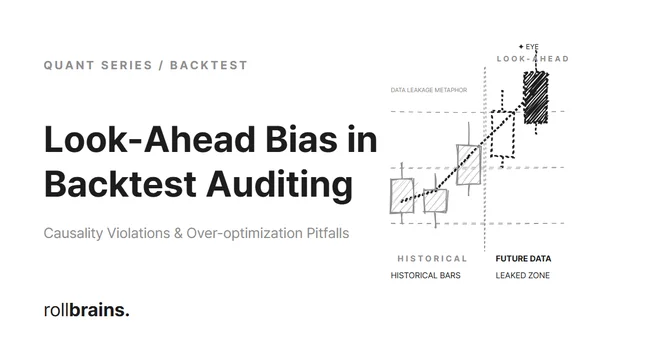
The Anatomy of Look-Ahead Bias: Auditing Volatility and Stop-Loss Causality

The Anatomy of Look-Ahead Bias: How Algorithmic Backtests Lie (And How to Audit Them)

💡 요약 / TL;DR - Look-Ahead Bias & Stop-Loss Causality Executive Summary (BLUF) Insidious Causality Leaks: Look-ahead bias and structural causality violations inflate backtest metrics, presenting a statistical illusion of high performance that translates into immediate capital loss in live execution. AI Semantic Blindspot: LLM coding assistants only validate syntactic compilation rather than semantic causality, generating flawless-compiling trading code that silently snoops into the future. Algorithmic Defenses: Enforcing constant level stop locks, prioritizing pre-finalized historical indicators (t-1), and implementing automated Pandas forward-mask unit tests are vital to ensure statistical survival. Three Systemic Defects in AI-Generated Backtests When developers ask AI coding assistants (such as ChatGPT, Claude, or Copilot) to generate trading bot backtests, the resulting code almost always compiles without syntactic runtime errors. However, beneath the clean syntax, these models routinely embed three fatal causality leaks that guarantee bankruptcy in real-world markets. ...
May 31, 2026 · 5 min · Steve
7 Ways Your Backtest Is Lying to You — Measured, Not Guessed

7 Ways Your Backtest Is Lying to You (Measured, Not Guessed)

💡 TL;DR — 7 Structural Failure Modes, Each Measured (BLUF) Look-Ahead Bias: A tight ATR trailing stop can produce a 93.3% win rate in backtest. That win rate is a mathematical artifact of the stop being set after the move it was supposed to protect against. Intrabar Ambiguity: When both stop-loss and take-profit fall inside one candle, the candle contains no information about which fired first. rollbrains measured this on 1,820 BTC trades: the real answer was a coin flip. Slippage: In a rollbrains altcoin grid test, ignoring dynamic slippage drove win rate from 48.2% to 31.5% — and flipped net expectancy negative. Entry Price: Two reasonable entry placements, same logic, same exits. One returned +0.875R per trade. The other returned +0.046R. A 19x gap from one decision. Survivorship Bias: Crypto funding rates are charged on notional, not margin. A 3-day hold with a 0.5% stop loses ~18% of 1R to funding alone — before any trade result. Regime Change: A strategy optimized for one volatility regime doesn’t travel. The Nasdaq-Corn study’s “5-day lag, r = −0.6355” claim could not be reproduced in a 6,467-trading-day DCC-GARCH re-validation and has been corrected — it came from a 17-day sample, and the correction itself is now this series’ measured example. Correlation ≠ Direction: An FX reversion model reverted 98.01% of the time. The individual trade win rate was 47.47%. These two numbers measure different things. Most guides on backtesting mistakes are lists of things to worry about. This one is different: every failure mode described here was measured in a rollbrains experiment, with real data, and the result disagreed with what a naive backtest would have shown. ...

June 8, 2026 · 14 min · Steve
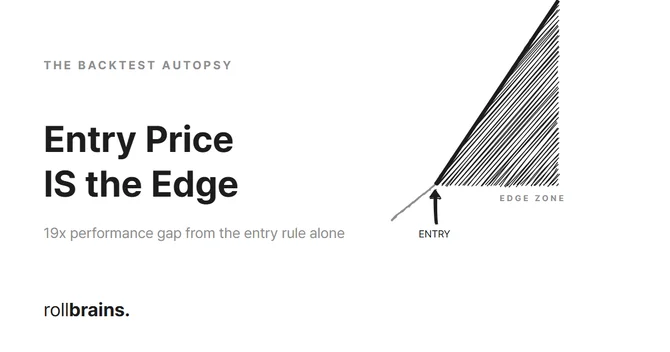
Why Your Entry Price IS the Edge

The Backtest Autopsy #1: Why Your Entry Price IS the Edge

💡 TL;DR / Summary - Entry Price Edge Empirical Key Takeaways (BLUF) Entry Location Governs Edge: Keeping all other parameters frozen, shifting the limit entry order from the projected pivot to the zone center caused the expected value to crash from +0.875R to +0.046R—a 19x collapse. Selection Bias Paradox: Deeper entries (zone center) do not buy cheaper; instead, they fail to fill on winning trades that reverse shallowly, selectively filling only failed, structure-breaking losing trades. Empirical Verification: We quantified this structural phenomenon across a massive dataset of 11,149 actual reversals, establishing entry price as the dominant driver of systematic edge. I changed one thing in a backtest. Not the strategy logic. Not the stop-loss, not the take-profit, not the position sizing, not the exit rules. Everything most traders call “the strategy” stayed frozen. ...

May 25, 2026 · 4 min · Steve