Order Book Microstructure and Dynamic Slippage Simulation Guide

Order Book Microstructure and Slippage Simulation: How Fixed Assumptions Hide Execution Ruin

💡 TL;DR - Order Book & Slippage Simulation Executive Summary (BLUF) Empirical Reality of Slippage: Standard backtesting engines that assume instant, guaranteed limit fills or rely on static, flat slippage parameters heavily distort the empirical reality of execution friction. In live cryptocurrency markets, ignoring non-linear Market Impact Costs can easily erode over $20$% of net algorithmic profits. Virtual Queue & Power-Law: Quantitative developers must incorporate dynamic power-law slippage modeling conditioned on localized pool depth and implement fill-probability filters ($P(\text{fill})$) that simulate queue position and time-to-fill priority under various volatility regimes. Execution Integrity: Incorporate defensive prompt constraints (Adaptive Sizing) to dynamically scale down entry sizes or perform split executions when trade volumes exceed 10% of the active order book depth. The Limit Order Mirage: The Flaw of 100% Fill Certainty When quantitative developers instruct AI coding engines (such as ChatGPT, Claude, or Copilot) to generate backtesting scripts using limit orders, the systems typically produce basic execution logic that looks like this: ...
June 1, 2026 · 5 min · Steve
7 Ways Your Backtest Is Lying to You — Measured, Not Guessed

7 Ways Your Backtest Is Lying to You (Measured, Not Guessed)

💡 TL;DR — 7 Structural Failure Modes, Each Measured (BLUF) Look-Ahead Bias: A tight ATR trailing stop can produce a 93.3% win rate in backtest. That win rate is a mathematical artifact of the stop being set after the move it was supposed to protect against. Intrabar Ambiguity: When both stop-loss and take-profit fall inside one candle, the candle contains no information about which fired first. rollbrains measured this on 1,820 BTC trades: the real answer was a coin flip. Slippage: In a rollbrains altcoin grid test, ignoring dynamic slippage drove win rate from 48.2% to 31.5% — and flipped net expectancy negative. Entry Price: Two reasonable entry placements, same logic, same exits. One returned +0.875R per trade. The other returned +0.046R. A 19x gap from one decision. Survivorship Bias: Crypto funding rates are charged on notional, not margin. A 3-day hold with a 0.5% stop loses ~18% of 1R to funding alone — before any trade result. Regime Change: A strategy optimized for one volatility regime doesn’t travel. The Nasdaq-Corn study’s “5-day lag, r = −0.6355” claim could not be reproduced in a 6,467-trading-day DCC-GARCH re-validation and has been corrected — it came from a 17-day sample, and the correction itself is now this series’ measured example. Correlation ≠ Direction: An FX reversion model reverted 98.01% of the time. The individual trade win rate was 47.47%. These two numbers measure different things. Most guides on backtesting mistakes are lists of things to worry about. This one is different: every failure mode described here was measured in a rollbrains experiment, with real data, and the result disagreed with what a naive backtest would have shown. ...

June 8, 2026 · 14 min · Steve
TradingView Pine v6 Footprint Guide

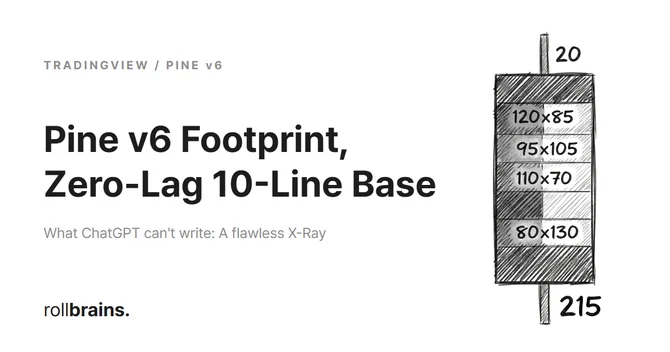
The Ultimate TradingView Pine v6 Footprint Guide: Build an Order Flow X-Ray in 10 Lines

💡 TL;DR / Summary - Key Takeaways Pine Script v6 Revolution: Replaces high-latency legacy v5 client-side arrays with the server-side native request.footprint() API, ensuring zero-lag and exact tick-level precision. Premium Plan Requirement: This API is resource-intensive and restricted to Premium and Ultimate plans. Lower-tier plans return na and render a blank chart silently. AI Generation Success: To prevent compiler and runtime failures (RE10047), custom prompts must feed the exact v6 footprint syntax and strictly enforce a single-call constraint. If you could peer inside a single candlestick as it moves up and down in real-time, seeing exactly where buyers and sellers are fighting and at what price levels — how would that change your trading? ...

May 28, 2026 · 7 min · Steve