💡 TL;DR / Summary - Remix vs LuxAlgo SMC Empirical Key Takeaways
- Independent Computation: TradingView Remix computes the SMC structure directly from raw OHLCV price data, completely independent of whether the LuxAlgo indicator is active on the chart.
- To-the-Dollar Match: Core structural levels (BOS at $77,640.00, CHoCH at $78,754.65) returned identical to the dollar, regardless of indicator presence.
- Complementary Roles: The free LuxAlgo indicator is highly economical for continuous visual monitoring, while the Remix agent excels at producing comprehensive on-demand analyses with specific risk scenarios.
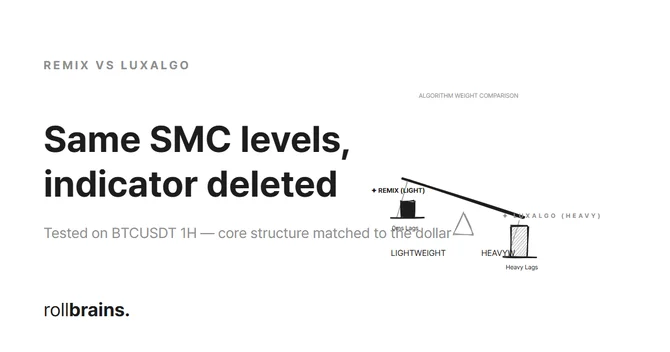
TradingView Remix and the LuxAlgo Smart Money Concepts indicator both mark up the same chart with BOS, CHoCH, order blocks, and liquidity zones. To find out whether Remix reads those levels from the indicator or computes them from raw price, I ran the same SMC analysis twice: once with LuxAlgo on the chart, then again after deleting it. The core structure levels came back identical to the dollar. Remix computes from raw price, independent of what the indicator draws. The two tools converge on the same structure but differ in how they output it, what they cost, and whether they repeat exactly.
This is a real test on BTCUSDT 1H, not a feature list. Both tools are free: the LuxAlgo SMC script is open-source with 140K+ likes, and Remix usage is included with any TradingView plan. For the usage-cost side, our weekly-limits test measured an SMC analysis at roughly 10 tools. Figures here reflect a session on 2026-05-24.
Affiliate link — I may earn a small commission at no extra cost to you. All test data referenced here is genuine and unaffected by affiliate arrangements.
Two Ways to Mark the Same Structure
LuxAlgo SMC is a chart overlay. You add it once and it stays on, drawing market structure in real time: internal and swing BOS/CHoCH, order blocks, fair value gaps, equal highs/lows, premium/discount zones. The logic is rule-based — swing pivots tracked as price levels, order blocks filtered by an ATR volatility measure, mitigation triggered when price closes through a level. Same input, same output, every time.
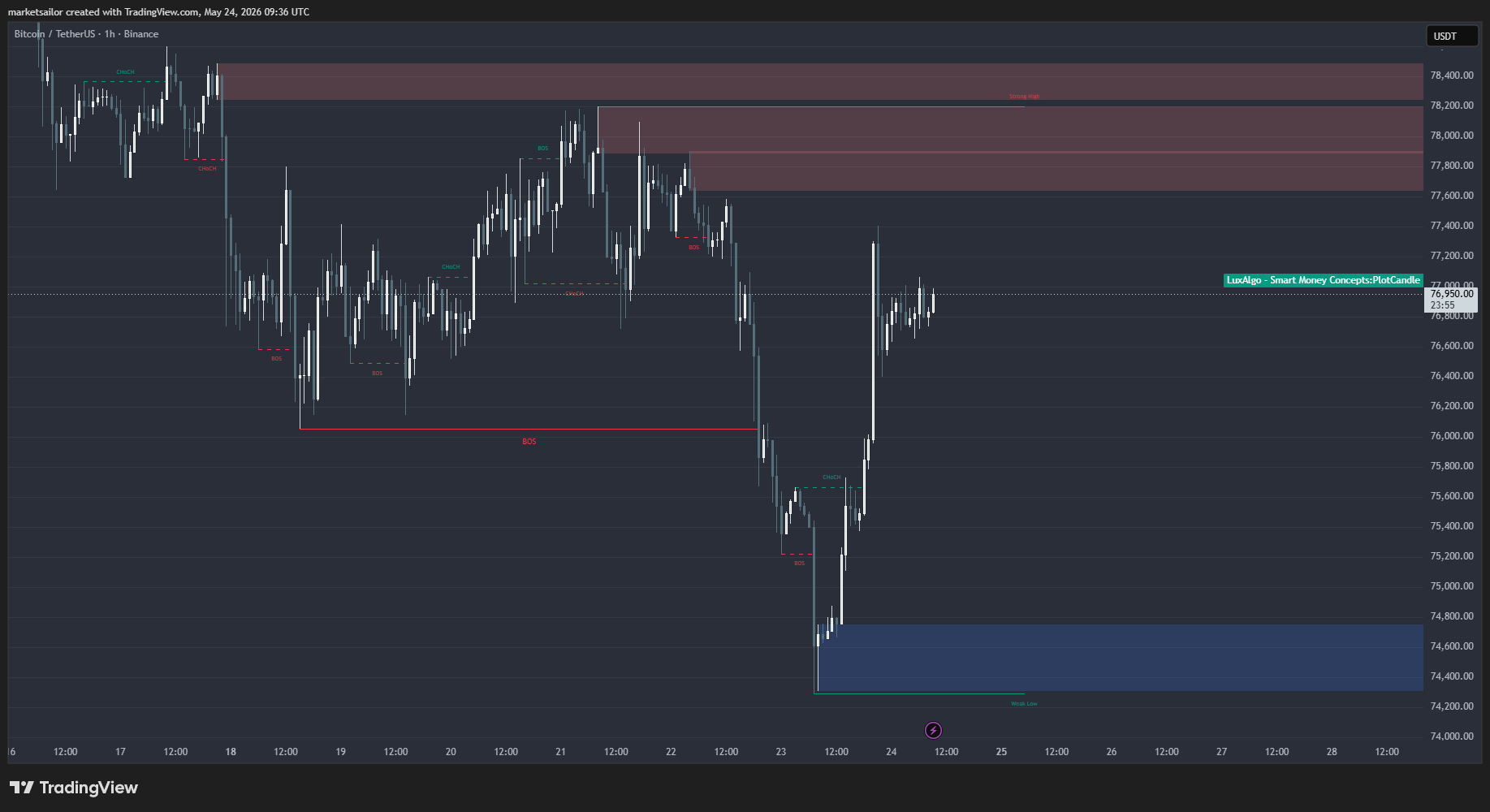 Chart by TradingView
Remix is the opposite shape. It is a conversational agent: you ask it to analyze the chart, it fetches data, and it answers in text. It does not stay on the chart as a layer. Its own reasoning trace during the test stated it would “fetch fresh OHLCV bars” and run a structured analysis — meaning it pulls raw price and computes structure on demand, not from whatever is drawn on screen.
That distinction is the whole question of this test. If Remix were reading the chart’s visual layer, deleting LuxAlgo should change its answer. So I checked.
The Test: Indicator On, Then Deleted
I asked Remix the same prompt twice on the same BTCUSDT 1H chart. The first run had the LuxAlgo SMC indicator active on the chart. For the second run, I removed the indicator entirely, then re-ran the identical prompt:
“Analyze the SMC structure of the current BTCUSDT 1H chart: identify BOS, CHoCH, order blocks, fair value gaps, and liquidity zones. For each, give the price level.”
If Remix were reading LuxAlgo’s drawn output, the second answer should degrade or shift once the indicator was gone. Here is what came back.
| SMC element | Run 1 (LuxAlgo on) | Run 2 (indicator deleted) | Match |
|---|---|---|---|
| CHoCH | $78,754.65 (May 16) | $78,754.65 (May 16) | Identical |
| BOS | $77,640.00 / $76,719.47 | $77,640.00 / $76,719.47 | Identical |
| Nearest bearish OB | $77,230.00–$77,922.01 | $77,230.00–$77,922.01 | Identical |
| Weak Low (SSL) | $74,289.60 | $74,289.60 | Identical |
| Bullish FVG | $76,012.22–$76,538.04 (27% filled) | $76,012.22–$76,538.04 (27% filled) | Identical to the fill % |
The core structure came back to the dollar — including the fair-value-gap fill percentage. Deleting the indicator changed nothing about the levels Remix reported. That settles the question: Remix computes SMC from raw OHLCV, not from the LuxAlgo overlay. The indicator and the agent arrive at the same structure independently because they are reading the same underlying price.
The practical upshot: the two tools cross-check each other. When LuxAlgo’s drawn order block and Remix’s reported order block land on the same price, that is two independent methods agreeing — not one copying the other.
Where the Two Runs Differed
The match was not total, and the difference is itself informative. Between the two runs, Remix re-stated the Strong High at a different level ($82,048 in run 1, $78,200 in run 2) and reorganized parts of the FVG list and the risk plan. The structural backbone (BOS, CHoCH, OB, SSL) was stable to the dollar; the framing layer around it was not.
That is the signature of an AI agent versus a rule-based script. LuxAlgo, given the same bars, draws the same thing every time — it is deterministic. Remix re-reasons on each call, so the hard levels stay put but the emphasis, the invalidation choice, and the secondary lists can shift run to run. Neither is “wrong”; they are different tools. If you need a value that is identical on every refresh, that is the indicator’s job. If you want a fresh read with scenarios and reasoning, that is the agent’s.
How They Differ in Practice
| Dimension | LuxAlgo SMC | TradingView Remix |
|---|---|---|
| Form | Always-on chart overlay | Conversational, on-demand |
| Output | Visual labels & zones | Text levels + scenarios + R:R |
| Cost | Free, unlimited | Free with plan; ~10 tools per SMC analysis |
| Determinism | Same input → same output | Re-reasons each call; core levels stable |
| Reading | Applies rules to price | Computes from raw OHLCV |
| Best at | Persistent visual monitoring | Context, scenarios, explanation |
The cost line matters for heavy users. LuxAlgo runs free and unlimited because it is a script on your chart. Remix consumes plan usage per analysis — about 10 tools for a full SMC read in our earlier test, which on a Premium plan is a fraction of a percent but on Free (0.25×) adds up fast. For continuous monitoring, the overlay is the economical choice; for a considered read with a trade plan attached, the agent earns its cost.
If you run heavy AI analyses often, a higher TradingView tier lifts the Remix ceiling. Affiliate link — Compare TradingView plans → New users get $15 off their first paid plan.
How LuxAlgo Detects Structure (Open Source)
Because the LuxAlgo SMC script is open-source under CC BY-NC-SA, you can read exactly how it decides what counts as structure — something you cannot do with a closed indicator or with Remix’s reasoning. Without reproducing the code, the method is: track swing pivots as price levels and mark a Break of Structure when price crosses a prior pivot; flip to Change of Character when the break runs against the prevailing swing trend; tag order blocks at the last opposing candle before a structural move, filtered out if the bar’s range exceeds roughly twice an ATR-based volatility measure; and mark a block “mitigated” once price closes back through it.
The takeaway is not the specific thresholds but the nature of the method: it is a fixed ruleset. That is why it is reproducible, and why deleting it and asking an AI to redo the same analysis is a fair test of the AI — the rules are knowable, so convergence is meaningful rather than coincidental.
Which One to Use
| If you want to… | Use |
|---|---|
| Keep structure drawn on the chart at all times | LuxAlgo SMC |
| Get a one-time read with scenarios and a trade plan | Remix |
| Cross-check a level two independent ways | Both — they converge |
| Stay entirely free with no usage cap | LuxAlgo SMC |
| Have structure explained, not just drawn | Remix |
These are not rivals to choose between. LuxAlgo gives you a persistent, deterministic visual map for free; Remix gives you an on-demand read with reasoning and a risk plan, at a small usage cost. Many traders will keep the overlay on for monitoring and call the agent when they want a structured second opinion. SMC itself carries no guarantee — even LuxAlgo’s own script notes there is no supporting data that these concepts trade inside genuine institutional liquidity — so treat both as structure-mapping aids, not signals.
FAQ
Q. Does Remix read the LuxAlgo indicator off my chart?
No. In this test, deleting LuxAlgo and re-running the same prompt returned the same core levels to the dollar. Remix computes SMC from raw OHLCV price data, not from the indicator’s drawings.
Q. Are LuxAlgo SMC and Remix both free?
Yes. The LuxAlgo Smart Money Concepts script is open-source and free. Remix usage is included with any TradingView plan, including Free, though heavier analyses consume more of your weekly allowance.
Q. Why did the two Remix runs differ slightly?
The core structure (BOS, CHoCH, order blocks, sell-side liquidity) was identical. The Strong High level, parts of the FVG list, and the risk plan were re-stated differently. An AI agent re-reasons on each call, so framing shifts while hard levels stay put — unlike the deterministic indicator.
Q. Which is more accurate for SMC?
They converge on the same structural levels, so neither is “more accurate” on the backbone. LuxAlgo is reproducible (same output every time); Remix adds interpretation and scenarios but varies in its framing between runs.
Q. How much usage does a Remix SMC analysis cost?
Roughly 10 tools per full analysis in our weekly-limits test — a fraction of a percent on Premium (5×), but a meaningful share of the Free tier’s small weekly allowance.
Q. Can I trust SMC levels for trading?
SMC is a structure-mapping framework, not a signal. LuxAlgo’s own script notes there is no data proving these levels coincide with real institutional activity. Use them as one input, not a trade trigger.
Sources
- LuxAlgo Smart Money Concepts (open-source script): https://www.tradingview.com/script/CnB3fSph-Smart-Money-Concepts-SMC-LuxAlgo/
- Remix usage-cost measurement: TradingView Remix Weekly Limits, Tested by Plan
- Test data: two Remix SMC analyses on BTCUSDT 1H, 2026-05-24 (indicator on / deleted)
Updates & Changelog
- 2026-05-24 — Initial publication. Two Remix SMC analyses run on BTCUSDT 1H, with the LuxAlgo SMC indicator first active, then deleted. Core structure levels matched to the dollar across both runs. Usage-cost figure referenced from the prior weekly-limits test. LuxAlgo detection logic summarized from its open-source script (CC BY-NC-SA); no code reproduced.
Nothing here is investment advice — treat it as educational. SMC is a structure-mapping framework with no guarantee of correspondence to institutional activity; both tools described here are analysis aids, not trade signals.
Related Research
- TradingView Remix: The Complete AI Copilot Guide: The hub guide for putting Remix’s core features to work day to day, building on the raw-price SMC comparison run in this test.
Frequently asked
Which is more accurate: LuxAlgo SMC or Remix-based indicators?
Can basic users load LuxAlgo SMC on TradingView?
Does Remix support Multi-Timeframe (MTF) analysis like LuxAlgo?
request.security() or request.footprint(), you can pull and analyze multiple timeframe trends on a single chart dashboard.Sources
- LuxAlgo Smart Market Concepts (SMC) Indicator Docsluxalgo.com
- TradingView Remix Specifications Pagewww.tradingview.com